
Prefer audio? Listen to the recorded version below.
“Ships of the world! Start your engines! Let the oil flow!”. Peace has ostensibly broken out in the Middle East; the Straits of Hormuz are open. Brent is $40 a barrel cheaper than six weeks ago. With rapidly changing circumstances the Fed and the Bank of England held interest rates at their June policy meetings while the European Central Bank and the Bank of Japan nudged them up (Japan to the highest nominal level since 1995). The SpaceX IPO blasted off, the shares initially soaring into the stratosphere on a 60% premium to the $135 offer price; settling back, even at Thursday’s $185 per share the company is valued at $2.4 trillion. Stock markets are humming. Wall-to-wall footie is on the telly. What’s not to like?
Sitrep as God sees it.
Keeping one foot firmly on the ground, it’s no bad thing occasionally to do a macro rain check on the durability of so many sunny dispositions.
As a reference point, go back two years. It is a metaphor for political mortality and geostrategic instability. Date: June 6th 2024; location: Omaha Beach; occasion: the 80th anniversary of the Allied landings in Normandy; scene: group photo of allies; framed: Presidents Biden and Macron, Chancellor Scholz and standing in for the AWOL prime minister Rishi Sunak, British Foreign Secretary David Cameron. Such a group of likely lads; whatever happened to them?
UK: Labour’s war with itself
Sunak sank; without trace. Keir Starmer, his successor, politically is already a dead man walking. Andy Burnham has convincingly secured a Westminster seat in the Makerfield by-election; whether by contest or coronation the odds are we’ll have our third prime minister since D-Day 2024 before the Labour Party conference this autumn (even if Starmer somehow survives, his authority will be so much weakened both in Cabinet and the wider parliamentary party that his will become a lame duck premiership).
Should Burnham win the leadership, speculation is rising about a snap election to secure a new mandate to lend legitimacy for a change of political direction. Supporters insist he should capitalise on his popularity across the left-wing and working class diaspora before the pressures of national politics erode it. Do it while Reform UK and Restore UK tear lumps out of each other (“The right wing monster eating its own children”). Despite a historic win at the Aberdeen by-election, do it while the Tories are nowhere near being ready to fight a general election. Strike while the iron is hot, even if it means losing some of the current large majority. The counter-argument is not to jeopardise that majority, use it as a security blanket until 2029 and to ignore the barbs and arrows of illegitimacy. If successful, going to the country now would put him on the front foot for five years; not doing so carries far less risk but limits his duration to less than three years, limits his room for manoeuvre and leaves him on the back foot labouring under the weight of the Starmer government baggage.
For whoever replaces Starmer, it is a political calculation: confidence; bravery; legitimacy; inheritance; the state of the opposition; and the extent of division or unity within his/her own party after a leadership contest.
If Burnham becomes leader and with a new mandate, expect a major lurch leftwards in policy, especially if, as is being suggested, Ed Miliband becomes his Chancellor. There will be haggling with the Office for Budget Responsibility over the fiscal guardrails and anxiety about the bond markets but the direction of travel is visible: a full-frontal assault on wealth, assets and high-income earners; central intervention in the private sector; nationalisation; more health and welfare spending; the supremacy of workers’ rights etc, none of which squares with the urgent need for economic growth and a vibrant, competitive economy. Expect also a manifesto commitment fully to rejoin the EU. With Miliband in charge of the purse strings, he would ensure no financial deviation from his own crazy carbon-zero energy policy and, despite being a pacifist, in an ex-officio capacity he would be co-chair of the Defence Growth Board.
USA: offensive in every sense
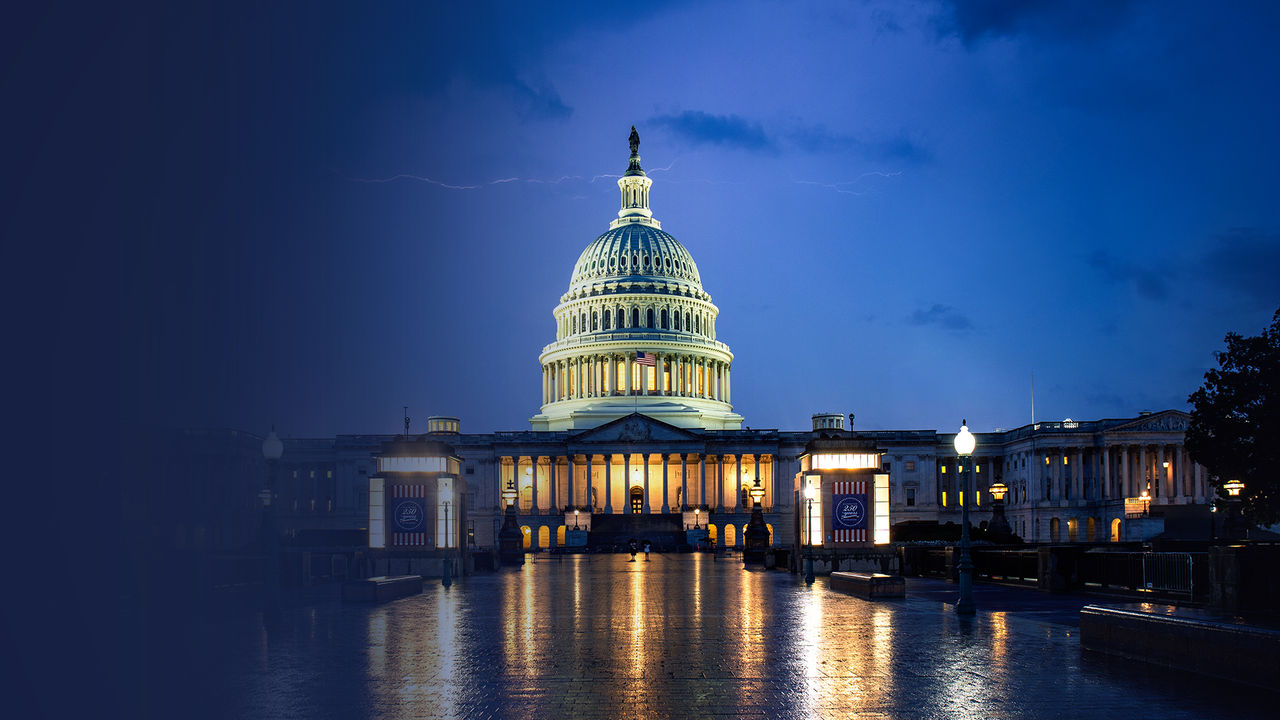
In 2024, only two months after being snapped photographically, Joe Biden was snapped politically: snapped in half by his own party as his failing physical and mental faculties became only too evident. Biden preached peace; with Donald Trump’s own unique perspectives, a very different, bullish, aggressive, self-proclaimed President of Peace is now firmly centre stage. Trump faces a Congressional mid-term reckoning with the voters in November; were he to lose his slim majorities in both houses, an impeachment petition would almost certainly follow and while the bar is high in the Senate, his survival could be less predictable than in his first term. More of Trump anon.
Germany: rumblings of Donner und Blitzen
The hapless Scholz and his SPD social democrat party suffered a resounding defeat at the hands of current Chancellor Merz in February 2025. But dark clouds are brewing over German politics: a relentless force, the far right Alternativ fur Deutschland is eclipsing every other party, opening up a six-point lead over Merz’s fading centre-right CDU in the national polls. With a stagnant German economy and a pro-Ukraine stance that inflames the Right, Merz and his CDU/SPD coalition are under pressure.
A raft of key state elections is due this September and next April. The AfD’s heartland has traditionally been in the old DDR; the litmus test of the extent of its growing influence nationally will be measured in such western regions as the Saar, North Rhine Westphalia, Bavaria and Bremen ahead of the federal elections early in 2029. The constitutional convention that the far right should be prevented from holding the levers of power, increasingly effected by post-election political stitch-up to keep them out, is having a demonstrably counterproductive effect among the electorate.
France: tons of smoke but which way from here?
By this time next year, Macron, the last of the four in our photo, will also be gone: French presidential terms are numerically limited by constitution. The next French assembly and presidential elections are due in 2027. In the post-Macron era and the immensely fluid and unpredictable state of French politics, today it is anybody’s guess as to whether France goes hard right, hard left, restores the political centre-ground or remains fractured and fragmented.
International tensions
If that is the state of play on their home turf, what about relations between allies? The landscape could not be more different or any less secure.
Peace, unity and fraternity among allies were the public order of the day in June 2024. Two years ago on that Norman beach, Sleepy Joe Biden delivered a tub-thumping homily. At the lectern, he was temporarily alert, temperamentally on fire. It was about bravery and sacrifice; international obligations and neighbourliness; holding up the ‘torch of freedom’, of democracy and the power of good over evil; it drew heavily on the fact that then, eight decades on from 1945, significant conflict and misery were present with us again in Europe with Ukraine being daily pulverised by an overbearing aggressive Russian bully; it declared before all that NATO was absolutely united, strengthened by the accessions of Finland and Sweden.
Biden’s was a rose-tinted perspective. It was oblivious to the consequences of his personal order for the US unilaterally to cut-and-run from Afghanistan in 2021, abandoning his NATO allies and the Afghan population (at least his NATO allies had an escape route; not so the Afghans consigned to a future locked in a repressive, impoverished, medieval society under a totalitarian regime), and his reluctance and marked lack of leadership in confronting Russia and refusal unequivocally to back Ukraine in 2022.
But the contrast with today could not be starker. Donald Trump’s National Security Strategy for the United States of America prescribes a wholly different perspective: one seen self-centredly through the American lens and in the American interest. It is an abrogation of international responsibilities. Trump’s competitive and combative instincts determine not only the preservation but the expansion and the dominance of America’s hegemony but only where it chooses. Neither partnership, diplomacy nor kumbaya is in Trump’s political DNA. His patience with what should be America’s allies is as thin and febrile as his tolerance and indulgence of Vladimir Putin are unfathomable and deeply troubling. Like a volatile unguided Exocet, on the global stage it is difficult to know where he will explode next and to what effect.
Iran: “Bravo!”
Which brings us to Trump’s long-awaited Memorandum of Understanding with Iran and the formalisation of a ceasefire with 60 days of negotiations to secure a lasting peace deal. “Bravo!” exclaimed Emmanuel Macron as Trump announced at the G7 Summit that he has signed the MOU: with no sense of sarcasm or irony, the French president apparently meant it.
Details are skeletal and will be fleshed out. But of what we do know and the passage of events since the end of February, Donald Trump has seemingly pulled off an amazing outcome: he has achieved precisely the opposite of what should have been the result.
He has alienated his NATO allies; he has undermined Israel, the country Iran and its proxies vow to see eviscerated and eradicated; American military power has been exposed as limited, leaden and one-dimensional; he has created massive uncertainties among the Gulf States as to their national security and who they can count upon to help them when faced with Iranian aggression; removing sanctions, thawing out $20 billion of frozen financial assets and intimating $350 billion of reparations for damage caused by the bombings, the Revolutionary Guard can see considerable cash resources for the military restoration of itself and its proxies; Iran retains control of the Strait (and has already declared its intention to charge tolls); in a case of back to the future and something it has years of practice of avoiding, Iran’s nuclear programme is supposed to be open to scrutiny and limited to the use for power-generation only, with the financial “bonus” reparation payments supposedly conditional on compliance and transparency; unless to be included in the detailed negotiation agenda, Iran’s ballistic missile programme appears no longer to be a subject of discussion. But worst of all, by negotiating and entreating with Tehran (when he had previously insisted on wholesale regime change or unconditional surrender), Trump has legitimised a violent, internationally aggressive and domestically repressive Iranian regime; he has enervated it and given it oxygen and agency. Bravo indeed.
As former President Obama crowed, “Trump has achieved an even worse deal than the one we got”. Trump hails it as a “total victory”. Obama is right. Trump has been outmanoeuvred and has handed leverage to the Iranians. They remain firmly in the game. From a western perspective, all the evidence so far points to the outcome being deficient and strategically illiterate. That is no victory, let alone a total one.
The omens for global security are not good, whether considering a resolution in Ukraine or the future security of Taiwan.
The travelling diplomatic circus moves on to Ankara for the annual NATO Summit on 7/8 July. The only certainty is that by then, Starmer will know for sure if his goose is about to be cooked and he faces summary eviction from Number 10. At what will be a seminal moment for NATO, the UK will arrive with limited money, limited intent and a prime minister with no authority.
Investment perspective
Markets are buoyed by peace in the Gulf and the blue sky opportunities for Artificial Intelligence. The World Cup is a tonic (a torture for some) and a great distraction. But the nasties remain, for the moment filed away as too difficult or to be deferred. Enjoy the sunshine!
The Jupiter Merlin Portfolios are long-term investments; they are certainly not immune from market volatility, but they are expected to be less volatile over time, commensurate with the risk tolerance of each. With liquidity uppermost in our mind, we seek to invest in funds run by experienced managers with a blend of styles but who share our core philosophy of trying to capture good performance in buoyant markets while minimising as far as possible the risk of losses in more challenging conditions.




The value of active minds: independent thinking
A key feature of Jupiter’s investment approach is that we eschew the adoption of a house view, instead preferring to allow our specialist fund managers to formulate their own opinions on their asset class. As a result, it should be noted that any views expressed – including on matters relating to environmental, social and governance considerations – are those of the author(s), and may differ from views held by other Jupiter investment professionals.
Fund specific risks
The NURS Key Investor Information Document, Supplementary Information Document and Scheme Particulars are available from Jupiter on request. The Jupiter Merlin Conservative Portfolio can invest more than 35% of its value in securities issued or guaranteed by an EEA state. The Jupiter Merlin Income, Jupiter Merlin Balanced and Jupiter Merlin Conservative Portfolios’ expenses are charged to capital, which can reduce the potential for capital growth.
Important information
This document is for informational purposes only and is not investment advice. We recommend you discuss any investment decisions with a financial adviser, particularly if you are unsure whether an investment is suitable. Jupiter is unable to provide investment advice. Past performance is no guide to the future. Market and exchange rate movements can cause the value of an investment to fall as well as rise, and you may get back less than originally invested. The views expressed are those of the authors at the time of writing are not necessarily those of Jupiter as a whole and may be subject to change. This is particularly true during periods of rapidly changing market circumstances. For definitions please see the glossary at jupiteram.com. Every effort is made to ensure the accuracy of any information provided but no assurances or warranties are given. Company examples are for illustrative purposes only and not a recommendation to buy or sell. Jupiter Unit Trust Managers Limited (JUTM) and Jupiter Asset Management Limited (JAM), registered address: The Zig Zag Building, 70 Victoria Street, London, SW1E 6SQ are authorised and regulated by the Financial Conduct Authority. No part of this document may be reproduced in any manner without the prior permission of JUTM or JAM.